
USS Preble is the only American destroyer with the advanced Helios laser weapon that can intercept aerial threats such as drones and missiles

A US warship equipped with the advanced Helios laser weapon is being forward-deployed to Japan’s Yokosuka naval base, south of Tokyo, as a “show of force” to potential rivals in the increasingly tense Indo-Pacific region, analysts say.
The Arleigh Burke-class guided-missile destroyer USS Preble departed the US Navy base in San Diego on Sunday and is scheduled to carry out tests of its Helios system – a high-energy laser with integrated optical-dazzler and surveillance – during its crossing of the Pacific, according to the navy in a statement.
The deployment coincides with the release of Navigation Plan 2024, the US Navy’s outlook on the challenges ahead. Issued by Admiral Lisa Franchetti, the chief of naval operations, the report states for the first time that the navy must be ready for the “possibility of war with the People’s Republic of China by 2027”.
The 30-page report identifies China as the greatest threat to US interests.
“The PRC presents a complex multi-domain and multi-axis threat. The PLA Navy, Rocket Force, Aerospace Force, Air Force and Cyberspace Force are coalescing into an integrated warfighting ecosystem specifically designed to defeat ours, backed by a massive industrial base,” it said.
“The PRC’s defence industrial base is on a wartime footing, including the world’s largest shipbuilding capacity,” it added.
The USS Preble is only one of 73 destroyers in its class to have been retrofitted with Helios, a weapon developed by Lockheed Martin and designed to intercept aerial threats, such as drones, missiles and even small boats. Commissioned in 2002, USS Preble was fitted with the laser weapon in 2021.
“It is obvious that the US is placing strong priority on the Indo-Pacific region and making sure that it has the best assets in the right areas for the contingencies it might face,” said Ryo Hinata-Yamaguchi, associate professor in Tokyo International University’s Institute for International Strategy.
“Put simply, the US wants its best weapons systems right on the front line.”
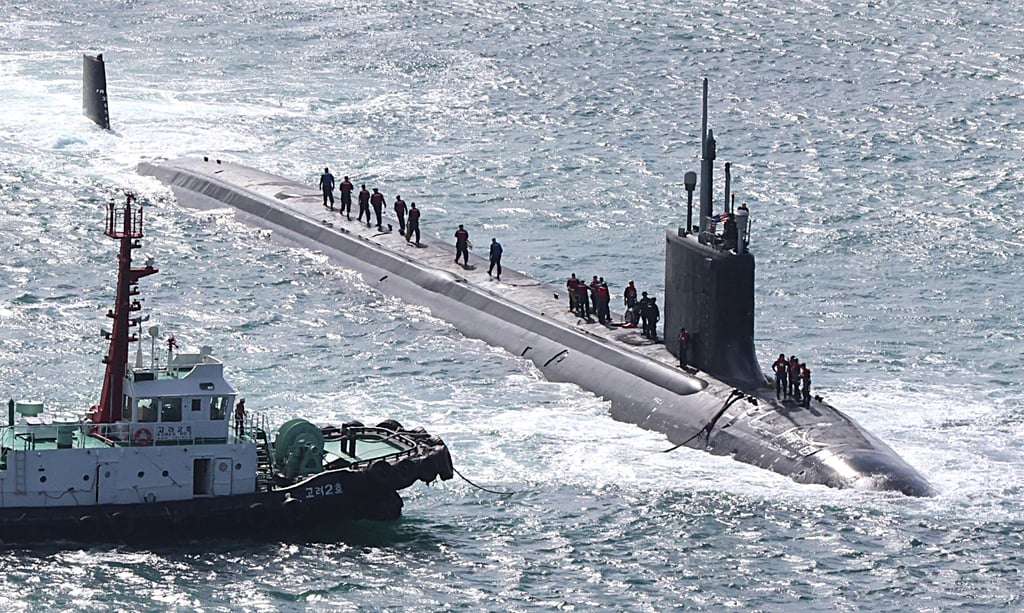
The second, parallel reason for the deployment of the USS Preble and other state-of-the-art warships in the region – the nuclear-powered attack submarine USS Vermont on Monday docked in the South Korean port of Busan for replenishment – is to underline Washington’s commitment to the security of the region.
“The US is now facing a powerful adversary in the region and this show of force is designed to send the message to Beijing that while China is strong, the US is stronger,” Hinata-Yamaguchi told This Week in Asia.
Helios is based on a 60kW high-energy laser that can be fired at a target at the speed of light and is designed to melt or overheat the target, causing it to malfunction or explode. The concept behind laser technology is not new, analysts agree, although it has taken decades of research to go from the drawing board to being mounted on warships.
Among the many advantages of laser-based weapons are the speed at which they are able to engage a target and their precision. They can also be fired as long as power is available, making them cheaper alternatives to conventional missiles or artillery rounds in destroying a target, a critical consideration as warfare increasingly embraces the use of drones swarms in attacks.
The manufacturer is understood to be working on a more powerful 120kW version of the weapon, which should be capable of destroying anti-ship cruise missiles.
The Nikkei newspaper reported that while the USS Preble is fitted with Helios, it remains in the at-sea testing phase, with more tests to be conducted as the ship crosses the Pacific and after it is based in Japan.
“The system has obviously been extensively tested already but it is important that the navy continues to conduct tests to determine how it works in less-than optimal conditions, such as in areas of high humidity, to make sure that it remains effective,” Hinata-Yamaguchi said.
The US Navy has 12 warships forward-deployed to Yokosuka, the largest US naval installation outside the US and the home port of the 7th Fleet. The Nimitz-class aircraft carrier USS George Washington is scheduled to be based at Yokosuka from mid-November.
Post a Comment